Claude's New Import Memory Feature: Switch AI Without Starting Over
Anthropic just launched Import Memory — a feature that lets you transfer your context from ChatGPT, Gemini, or any AI into Claude in under a minute. Here's how it works and why it matters.
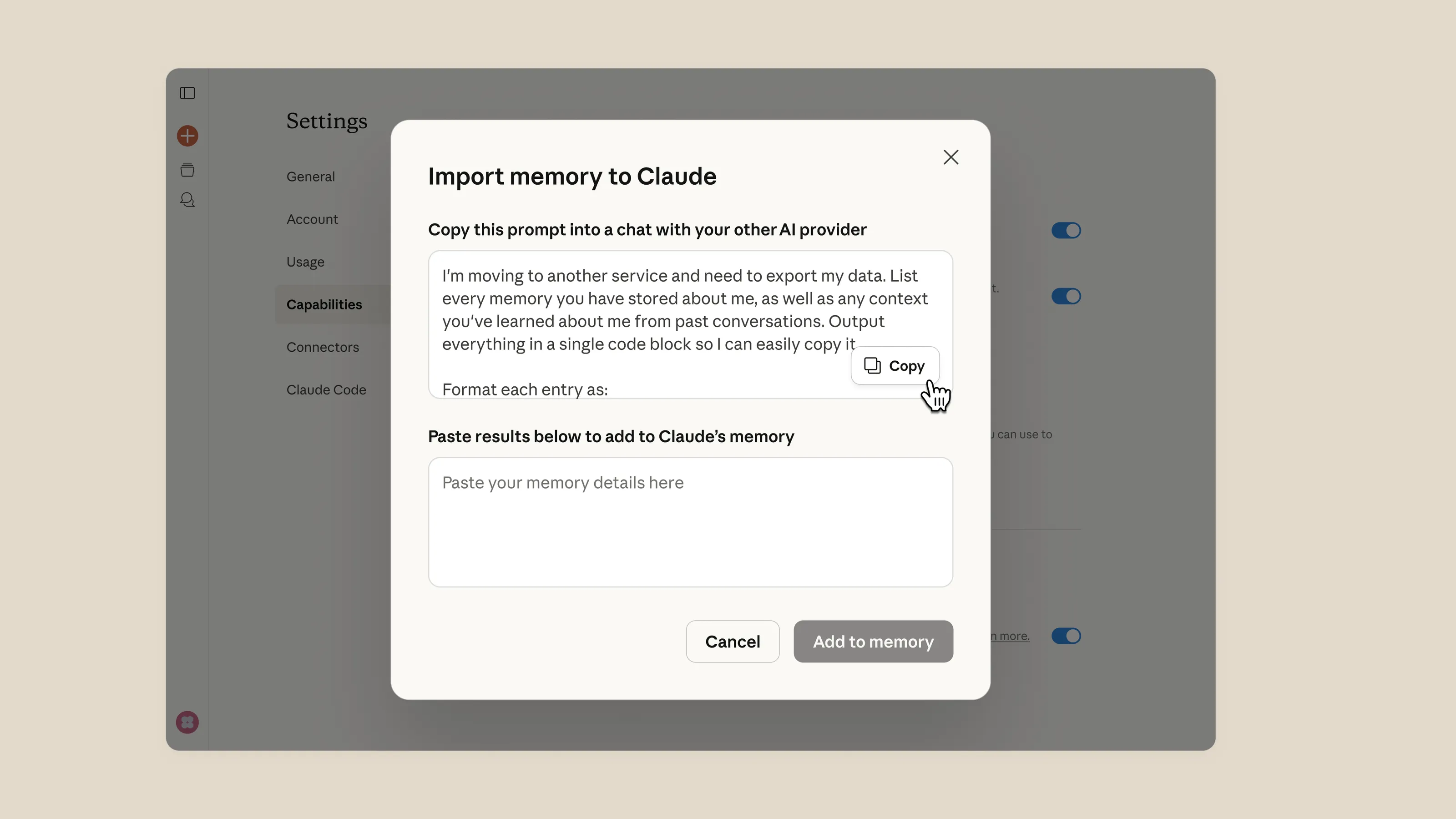
If you've been using Claude, ChatGPT or Gemini for months, you know the feeling: your AI gets you. It knows your writing tone, your projects, your preferences, your quirks. And that's exactly why switching to another AI feels impossible — you'd have to start from zero.
Anthropic just solved that problem.
What is Import Memory?
Claude now lets you transfer your stored memories from any AI provider — ChatGPT, Gemini, or others — directly into Claude's memory system. The process takes less than a minute, requires zero technical skills, and works entirely through copy and paste.
The feature is live at claude.com/import-memory.
How Does It Work?
The process is deliberately simple:
Step 1: Visit claude.com/import-memory. Anthropic provides a ready-made prompt designed to extract all your stored context from your current AI.
Step 2: Copy that prompt and paste it into a chat with your current AI assistant (ChatGPT, Gemini, etc.). The AI will output all the memories it has stored about you — your preferences, project context, communication style, and more.
Step 3: Copy that output and paste it into Claude's memory settings (Settings > Capabilities > View and edit memory). Claude processes the information and stores it as individual memory edits.
That's it. Within 24 hours, Claude will have fully integrated your imported context, and your conversations will feel like you've been using it for months.
For ChatGPT users specifically, there's an alternative: you can go to Settings > Personalization > Manage Memories in ChatGPT and copy the entries directly from there.
What Gets Imported?
Claude extracts and stores things like:
- Your communication and writing style preferences
- Project context and technical stack information
- Work preferences and workflow habits
- Formatting and tone guidelines you've established
- Role and professional context
It's worth noting that Claude's memory is designed to focus on work-related context. Purely personal details unrelated to work might not be retained automatically, but you can always add those manually through the memory settings.
Key Details to Know
- Availability: Pro, Max, Team, and Enterprise plans (all paid plans)
- Merging, not overwriting: Imported memories are merged with any existing Claude memories — nothing gets replaced
- Full transparency: You can view, edit, and delete any memory Claude stores about you
- Exportable: You can export your Claude memories at any time, so there's no vendor lock-in on Anthropic's side either
- Security: Memory is encrypted at rest and is not used for model training
- Experimental: Anthropic notes this feature is still in active development, so Claude may not always perfectly incorporate every imported memory
Why This Matters
This is one of the smartest competitive moves in the AI assistant space right now. The biggest barrier to switching AI tools has never been pricing or features — it's the accumulated context. Months of conversations create a personalized experience that's incredibly hard to replicate from scratch.
By eliminating that switching cost entirely, Anthropic is making a confident bet: they believe Claude's quality will speak for itself once people actually try it with their full context.
For anyone working in AI automation or evaluating tools for their team, this changes the equation. You can now run a genuine side-by-side comparison of Claude versus ChatGPT without sacrificing months of accumulated workflow context.
How to Try It
- Go to claude.com/import-memory
- Follow the two-step copy-paste process
- Wait up to 24 hours for full integration
- Start a new chat and ask Claude: "What do you remember about me?"
If you've been on the fence about trying Claude, the fence just got a lot lower.
What do you think about memory portability between AI providers? Is this the future, or just a competitive tactic?